29 December 2017

Is Religion Child Abuse? - Christopher Hitchens

First part of Chapter Sixteen from the book ''GOD IS NOT GREAT''
How Religion Poisons Everything
Published by Atlantic Books, London in 2007

Christopher Eric Hitchens (13 April 1949 - 15 December 2011) was an Anglo-American author, columnist, orator, religious and literary critic, social critic, and journalist. Hitchens was the author, co-author, editor or co-editor of over 30 books, including five collections of essays, on politics, literature and religion.

When we consider whether religion has ''done more harm than good'' - not that this would say anything at all about its truth or authenticity - we are faced with an imponderably large question. How can we ever know how many children had their psychological and physical lives irreparably maimed by the compulsory inculcation of faith? This is almost as hard to determine as the number of spiritual and religious dreams and visions that came ''true'', which in order to possess even a minimal claim to value would have to be measured against all the unrecorded and unremembered ones that did not. But we can be sure that religion has always hoped to practice upon the unformed and undefended minds of the young, and has gone to great lengths to make sure of this privilege by making alliances with secular powers in the material world.
    One of the great instances of moral terrorism in our literature is the sermon preached by Father Arnall in James Joyce's Portrait of the Artist as a Young Man. This disgusting old priest is reading Stephen Dedalus and his other young ''charges'' for a retreat in honor of Saint Francis Yavier (the man who brought the Inquisition to Asia and whose bones are still revered by those who choose to revere bones). He decided to impress them with a long and gloating account of eternal punishment, of the sort which the church used to mandate when it still had the confidence to do so. It is possible to quote the entire rant, but two particularly element - concerning the nature of torture and the nature of time - are of interest. It is easy to see that the priest's words are precisely to frighten children. In the first place, the images are themselves childlike. In the torture section, the very devil himself makes a mountain shrivel like wax. Every frightening malady is summoned, and the childlike worry that this pain might go on forever is deftly played upon. When it comes to the picture of a unit of time, we see a child on the beach playing with grains of sand, and then the infantile magnification of units (''Daddy, what if there were a million million million squillion kittens: would they fill up the whole world?''), and then, adding further multiplicities, the evocation of nature's leaves, and the easily conjured fur and feathers and scales of the family pet. For centuries, grown men have been paid to frighten children in this way (and to torture and beat and violate them as well, as they also did in Joyce's memory and the memory of countless others).
    The other man-made stupidities and cruelties of the religious are easy to detect as well. The idea of torture is as old as the nastiness of mankind, which is the only species with the imagination to guess what it might feel like when imposed upon another. We cannot blame religion for this impulse, but we can condemn it for institutionalizing and refining the practice. The museums of medieval Europe, from Holland to Tuscany, are crammed with instruments and devices upon which holy men labored devoutly, in order to see how long they could keep someone alive while being roasted. It is not needful to go into further details, but there were also religious books of instruction in this art, and guides for the detection of heresy by pain. Those who were not lucky enough to be allowed to take part in the auto-da-fé (or ''act of faith'', as a torture session was known) were permitted free rein to fantasize as many lurid nightmares as they could, and to inflict them verbally in order to keep the ignorant in a state of permanent fear. In an era where there was little enough by way of public entertainment, a good public burning or disembowelment or breaking on the wheel was often as much recreation as the saintly dared to allow. 
Tertullian, full name
Quintus Septimius Florens Tertullianus,
 c. 155 – c. 240 AD,
 was a prolific early Christian author from
Carthage in the Roman province of Africa
Nothing proves the man-made character of religion as obviously as the sick mind that designed hell, unless it is the sorely limited mind that has failed to describe heaven-except as a place of either worldly comfort, eternal tedium, or (as Tertullian thought) continual relish in the torture of others.
    Pre-Christian hells were highly unpleasant too, and called upon the same sadistic ingenuity for their invention. However, some of the early ones we know of - most notably the Hindu - were limited in time. A sinner, for example, might be sentenced to a given number of years in hell, where every day counted as 6,400 human years. If he slew a priest, the sentence thus adjusted would be 149,504,000,000 years. It was left to Christians to find a hell from which there was no possible appeal. (And the idea is easily plagiarized: I once heard Louis Farrakhan, leader of the heretical black-only ''Nation of Islam'', as he drew a hideous roar from a mob in Madison Square Garden. Hurling spittle at the Jews, he yelled: ''And don't you forget - when it's God who puts you in the ovens, it's FOREVER!).
    The obsession with children, and with rigid control over their upbringing, has been part of every system of absolute authority. It may have been a Jesuit who was first actually quoted as saying: ''Give me the child until he is ten, and I will give you the man'', but the idea is very much older than the school of Ignatius Loyola. Indoctrination of the young often has the reverse effect, as we also know from the fate of many secular ideologies, but it seems that the religious will run this risk in order to imprint the average boy or girl with enough propaganda. What else can they hope to do? If religious instruction were not allowed until the child had attained the age of reason, we would be living in a quite different world. Faithful parents are divided over this, since they naturally hope to share the wonders and delights of Christmas and other fiestas with their offspring (and can also make good use of a god, as well as of lesser figures like Santa Claus, to help tame the unruly) but mark what happens if the child should stray to another faith, let alone another cult, even in early adolescence. The parents will tend to proclaim that this is taking advantage of the innocent. All monotheisms have, or used to have, a very strong prohibition against apostasy for just this reason. In her Memories of a Catholic Girlhood, Mary McCarthy remembers her shock at learning from a Jesuit preacher that her Protestant grandfather - her guardian and friend - was doomed to eternal punishment because he had been baptized in the wrong way. A precociously intelligent child, she would not let the matter drop until she had made the Mother Superior consult some higher authorities and discover a loophole in the writings of Bishop Athanasius, who held that heretics were only damned if they rejected the true church with full awareness of what they were doing. Her grandfather, then, might be sufficiently unaware of the true church to evade hell. But what an agony to which to subject an eleven-year-old girl! And only think of the number of less curious children who simply accepted this evil teaching without questioning it. Those who lie to the young in this way are wicked in the extreme......................

27 December 2017

JAMES JOYCE’S BOOK REVIEW IN THE DAILY EXPRESS on 19 November 1903

Borlase and Son by T. Baron Russell 

'Borlase and Son' has the merit, first of all, of actuality'. As the preface is dated for May last, one may credit the author with prophetic power, or at least with that special affinity for the actual, the engrossing topic, which is a very necessary quality in the melodramatist. The scene of the story is the suburban district about Peckham Rye, where the Armenians have just fought out a quarrel, and, moreover, the epitasis (as Ben Jonson would call it) of the story dates from fall of stocks incident upon a revolution among the Latin peoples of America.
But the author has an interest beyond that derivable from such allusions. He has been called the Zola of Camberwell, and, inappropriate as the pepithet is, it is to Zola we must turn for what is, perhaps, the supreme achievement in that class of fiction of which 'Borlase and Son' is a type. In 'Au Bonheur des Dames' Zola has set forth the intimate glories and shames of the great warehouse – has, in fact, written an epic for drapers; and in 'Borlase and Son', a much smaller canvas, our author has drawn very faithfully the picture of the smaller 'emporium', with its sordid avarice, its underpaid labour, its intrigue, its 'customs of trade'.
The suburban mind is not invariably beautiful, and its working is here delineated with unsentimental vigour. Perhaps the unctuousness of old Borlase is somewhat overstated, and the landladies may be reminiscent of Dickens. In spite of its 'double circle' plot, 'Borlase and Son' has much original merit, and the story, a little slender starveling of a story, is told very-neatly and often very humorously. For the rest, the binding of the book is as ugly as one could reasonably expect.  

James Joyce

For more information about this review go to The James Joyce Centre - http://jamesjoyce.ie/tag/t-baron-russell/


17 September 2017

J. P. Donleavy's Ireland

 In All Her Sins  Some of Her Graces
(Full Documentary)


14 September 2017

J.P. Donleavy, Acclaimed Author of ‘The Ginger Man,’ Dies at 91

By ANITA GATES  13th September, 2017 - The New York Times -

The novelist and playwright J. P. Donleavy at 
Levington Park, the County Westmeath, Ireland, estate 
where he had lived since the 1970s. 
photo: Kenneth O Halloran  
J. P. Donleavy, the expatriate American author whose 1955 novel “The Ginger Man” shook up the literary world with its combination of sexual frankness and outrageous humor, died on Monday at a hospital near his home in Mullingar, County Westmeath, Ireland. He was 91.
His sister, Mary Rita Donleavy, said the cause was a stroke.
Mr. Donleavy had considerable trouble finding a publisher for “The Ginger Man,” his bawdily adventurous story of 1940s university life in Dublin, which he described to The New York Times in 2000 as “celebratory, boisterous and resolutely careless mayhem.”
The playwright Brendan Behan, a friend, suggested that Mr. Donleavy send the manuscript to Olympia Press in Paris. This worked out well, in that Olympia accepted the book, and not well, in that it was published as part of the Traveler’s Companion series, which was known for erotica.
“That was basically the end of my career,” Mr. Donleavy told The Times. “I was ‘a dirty book writer’ out of Paris.” In fact, he went on to write many other successful novels.
“The Ginger Man” — whose bohemian American-in-Ireland antihero, Sebastian Dangerfield, has been described as impulsive, destructive, wayward, cruel, a monster, a clown and a psychopath — was both banned and burned in Ireland. When it was published in the United States in 1958, Chapter 10 was omitted, along with numerous sentences here and there.
The novel eventually won critical acclaim and public acceptance, so much so that it is now considered a contemporary classic, selling more than 45 million copies worldwide. Mr. Donleavy was compared to James Joyce and hailed as a forerunner of both the black humor movement and the London playwrights known as the Angry Young Men.

“What really makes ‘The Ginger Man’ a vital work,” Norman Podhoretz, the longtime editor of Commentary, wrote, “is the fact that it both reflects and comments dramatically on the absurdities of an age clinging to values in which it simply cannot believe and unable to summon up the courage to find out what its moral convictions really are.”

For the whole article go to: The New York Times

15 January 2017

E. du Perron - 17th February, 1931

E. du Perron
[1899-1940]
Post scriptum in his letter from 17th February, 1931 to his friend and colleague Menno ter Braak:
Menno ter Braak
[1902-1940]

I will bring with me for you: Les lauriers sont coupés by Ed. Dujardin, a charming little book, and the first example of the monoloque intérieur (stream of consciousness); to which ànd Joyce ànd Larbaud owe a great deal...............


Édouard Dujardin
[1861-1949]
[Menno ter Braak / E.  du Perron - Briefwisseling 1930-1940 - deel 1 - G.A. van Oorschot, Amsterdam - MCMLXII]

04 August 2016

My Little Town

James Joyce and Italo Svevo: The Story of a friendship
By Stanly Price
Somerville Press 276 pp £14

A review by Jan Morris in today's Literary Review

This fascinating work of scholarship concerns the association between two great 20th-century writers and the city that brought them together. The writers were the Italian Italo Svevo (1861–1928) and the Irishman James Joyce (1882–1941). The city was Trieste (45˚38’N 13˚46’E).

All three – the two men and the city – were almost equally complex in status, origin, style, condition and intention. To my dilettante mind the governing presence of the triad, binding it together in a kind of posthumous trinity, was the city, standing as it did upon an ethnic and historical fault line, and notorious for its genius loci, a gale-force wind called the bora.

The three of them are properly matched, and for me perhaps the most telling passage in the book (which is essentially a work of advanced cultural reportage) describes the two writers walking together in the city when the bora blew in one day. An eyewitness reported that they clung like mountain climbers to the safety ropes fixed in the downtown streets, but never stopped talking as the genius howled around them.

They met in Trieste in 1907: Joyce was scraping a living teaching English to Italian residents and Svevo came to him for lessons. Nothing in the tale, though, is as simple as that. Svevo, who was born Ettore Schmitz, was twenty years older that his teacher. He was a prominent local businessman whose family had enriched itself by making a unique kind of underwater paint, and he was not yet a writer at all. His only vice, it seems, was chain-smoking. Joyce, on the other hand, was already writing books of startling originality, was nearly always in debt and was a notorious drunkard. Yet the two, it seems, recognised the genius in each other, however latent, and were to remain friends and colleagues for life.

To read more go to: The Little Review

15 January 2016

James Joyce - Scientist of Letters

...he was absolutely without an equal.

The New Republic's obituary for James Joyce, 1882-1941

by The New Republic

January 20, 1941
Detail of a photo by Gisèlle Freund
James Joyce died in Switzerland, the last truly neutral country in western Europe. Since his escape from France, he had been living with his family in Zurich—in the same house, we are told, that they occupied in the World War. He was there twenty-six years ago when Romain Rolland, also a refugee in Switzerland, published Above the Battle. But Joyce was not so much above as completely outside the battle. He was working as much as 16 hours a day on the writing of Ulysses, a task that seemed more important to him than the fate of the warring countries. After leaving Ireland in 1904, he never permitted himself to make a statement on any political issue. He was the leading representative in our time, and perhaps in all times, of the theory of literature as a pure art almost

Literature as a pure art approaches the nature of pure science. And Joyce was also the great research scientist of letters, handling words with the same freedom and originality that Einstein handles mathematical symbols. The sounds, patterns, roots, and connotations of words interested him much more than their definite meanings. One might say that he invented a non-Euclidean geometry of language; and that he worked over it with doggedness and devotion, as if in a laboratory far removed from the noises of the street. This does not mean that he neglected to present human beings in his novels. Stephen Dedalus and his father, Leopold and Molly Bloom, even H. C. Earwicker of Finnegans Wake, are figures that will not be forgotten. But they are figures that are analyzed exhaustively in repose rather than being presented in action. And the side of them that held Joyce’s interest was their subconscious—that is, the side that medical scientists like to deal with. Moreover, even the strongest of his characters seem dwarfed by the great apparatus of learning that he brings to bear on them. They are almost like atoms being smashed by a 250-ton cyclotron.

These are some of the reasons why Joyce was not a writer of the same magnitude as Tolstoy or Stendhal or Dickens or any of the great men whose subject was human actions in their social background. In his own field, however, he was absolutely without an equal. There are very few serious novels of the last twenty years that do not show traces of his influence, even if only at third hand. The writers of the world owe him an enormous debt for making discoveries that have opened new horizons even to those who completely disagree with Joyce’s idea of literature. They will miss him all the more because, in the hard years that lie ahead of us, it is doubtful whether any great scientist of letters will have the opportunity to carry on his work. Perhaps there will not even be neutral countries to which they can escape.

Under Milk Wood by Dylan Thomas

Under Milk Wood is a 1954 radio drama by Welsh poet Dylan Thomas, commissioned by the BBC and later adapted for the stage. This film version, Under Milk Wood directed by Andrew Sinclair, was released in 1972. With Richard Burton reprising his role, also featured Elizabeth Taylor, Peter O'Toole, Glynis Johns, Vivien Merchant and other well-known actors, including Ryan Davies as the "Second Voice". It was filmed on location in Fishguard, Pembrokeshire, and at Lee International Film Studios, London.

An omniscient narrator invites the audience to listen to the dreams and innermost thoughts of the inhabitants of a fictional small Welsh fishing village Llareggub ("bugger all" backwards).

They include Mrs. Ogmore-Pritchard, relentlessly nagging her two dead husbands; Captain Cat, reliving his seafaring times; the two Mrs. Dai Breads; Organ Morgan, obsessed with his music; and Polly Garter, pining for her dead lover. Later, the town awakens and, aware now of how their feelings affect whatever they do, we watch them go about their daily business.  


11 December 2015

Joyce in Bloom - Christopher Hitchens

Echoing Homer, riffing on Shakespeare, teeming with puns, palindromes, and allusions, Ulysses was a revolutionary exploration of the consciousness of its hero, Leopold Bloom. On the hundredth “Bloomsday,” the author bows to James Joyce’s novel, so long a target of censors, for the delights and discoveries it offers with every reading. (Published in Vanity Fair)


Asurly English overseer is standing at the entrance to a construction site in London. It’s a filthy, wet day. He sees approaching him a shabby figure, with clay pipe clenched in mouth and a battered raincoat, and scowlingly thinks, Another effing Mick on the scrounge. The Irishman shambles up to him and asks if there’s any casual job going. “You don’t look to me,” says the supervisor, “as if you know the difference between a girder and a joist.” “I do, too,” says the Irishman indignantly. “The first of them wrote Faust and the second one wrote Ulysses.”
This is my favorite “Irish” joke, not just because it revenges itself on generations of nasty English caricature—to have represented the Irish, the people of Swift and Wilde and Shaw and Yeats, as stupid, of all things— but because it is itself Joycean. His universe of words was a torrent of puns, palindromes, parallels, parodies, and plagiarisms (with a good deal of Parnell stirred into the alliteration). Every now and then I will see a word as if for the first time, and suddenly appreciate that Evian is “naïve” spelled backward, or that Bosnia is an anagram of “bonsai.” Preparing some salad the other day, I murmured, “I knew Olive Oyl before she was an extra virgin.” Joyce could do this, at an infinitely higher standard of multiple entendre, drawing on several languages, for pages on end, so that—depending on your level of awareness, and your capacity to spot new allusions and analogies—you never reopen the same book of his, or even the same chapter, without realizing that you are holding a new text in your hands and haven’t really read it before.
Word games and word jokes are the special province of growing children who are coming into language for the first time (lucky them). And, lucky for us, Joyce was a startling case of infantilism and arrested development. Why, just for a start, did he pick June 16, 1904, as the day on which Mr. Leopold Bloom of Dublin, at first alone and then in the company of Stephen Dedalus, mimics the several stages of Homer’s Odyssey before dropping anchor with his blowsy Penelope, the dirty-minded Molly Bloom? On that day the newspapers reported on a terrible ferry accident at New York’s Hell Gate and a war—between Russia and Japan—that would curtain-raise the Great War of 1914. These events are mulled over in the city, along with a spectacular reversal of fortune at the horse races, as Bloom goes on his way. But this wasn’t what had fixed the date forever in the mind of James Joyce. On that day, he had made a rendezvous with a chambermaid, by the marvelous name of Nora Barnacle, who had newly arrived from Galway. She had failed to keep their first appointment (after he had initially picked her up in the street) and by a nice coincidence kept him standing outside the house of Oscar Wilde’s father, on Merrion Square. But the second date exceeded his expectations. The couple took a walk out to Ringsend, beyond the city’s docks, where, as Joyce later told her in a molten letter, it was not he who made a move but “you who slid your hand down inside my trousers and pulled my shirt softly aside and touched my prick with your long tickling fingers and gradually took it all, fat and stiff as it was, into your hand and frigged me slowly until I came off through your fingers, all the time bending over me and gazing at me out of your quiet saintlike eyes.”
A century later, the literary world will celebrate the hundredth “Bloomsday,” in honor of the very first time the great James Joyce received a handjob from a woman who was not a prostitute.
Many fine writers have sought to handle this delicate yet simple subject. One thinks of Mark Twain’s “Some Thoughts on the Science of Onanism,” or of Martin Amis, who did a good deal of hard and valuable reflection about handjobs in Money, and naturally of Philip Roth’s Portnoy (“I am the Raskolnikov of jerking off!”). But, all too often, the subject matter here is the humble, unassuming, solitary version, sometimes adopted for reasons of economy (“Overheads are generally low,” as Amis’s John Self ruefully reflects) as well as for reasons of, well, solitude. Though it may be possible to take pride in one’s work in this department, also. Joyce certainly did. When a stranger in a café in Zurich seized him by the mitt and exclaimed, “May I kiss the hand that wrote Ulysses,” Joyce responded, “No—it did lots of other things too.” But the greatest effusion ever unleashed by a single, properly managed, and expertly administered (and how often can you say that?) female-to-male handjob is beyond doubt the 735-page mastur-piece that was first published by Shakespeare and Company in Paris, in just 1,000 numbered editions, in February of 1922—since which date, our concept of the novel has revolutionized itself.
I shall be returning to self-abuse as a theme (trust me), but I want to give just a slight indication of the influence the book has had. I knew that George Orwell, in his second novel, A Clergyman’s Daughter, published in 1935, had borrowed from Joyce for his nighttime scene in Trafalgar Square, where Deafie and Charlie and Snouter and Mr. Tallboys and The Kike and Mrs. Bendigo and the rest of the bums and losers keep up a barrage of song snatches, fractured prayers, curses, and crackpot reminiscences. But only on my most recent reading of Ulysses did I discover, in the middle of the long and intricate mock-Shakespeare scene at the National Library, the line “Go to! You spent most of it in Georgina Johnson’s bed, clergyman’s daughter.” So now I think Orwell quarried his title from there, too.
Then take the vast, continuing controversy over the bigotry of T. S. Eliot. In a notorious lecture entitled “After Strange Gods,” delivered at the University of Virginia in 1933, Eliot had said that the presence of “too many free-thinking Jews” was “undesirable” in a well-ordered society. Seeking to define what was meant by a traditional community, he proposed that we call it “the same people, living in the same place.” And this deceptively simple formulation is taken word for word from Leopold Bloom, who offers it in Barney Kiernan’s pub when challenged, and then challenged again, by a violently anti-Jewish Irish nationalist. Nobody knows why Eliot chose to quote Bloom, without attribution, in a public address designed to attack Jewish influence. All we know is that he admired Joyce extravagantly, and that a novel mined by Orwell and Eliot within a year or so of each other, when Ulysses was still a banned book, is a considerable literary force.
In some intuitive manner, Joyce seems to have had the premonition that the Jewish question would be crucial to the 20th century. (He was to die in 1941 while fleeing the German advance in Europe.) When not with Nora, or when not writing her frenziedly masturbatory letters, far, far fiercer than the mild incitements that Bloom sends to and receives from his mystery lady, he sought out Jewish girls (perhaps to be certain that they were not Catholics). One of Bloom’s first actions is to stop at a pork butcher’s and, in this improbable setting, to pick up a Zionist leaflet from an organization based in Berlin. Joyce admired the Jews because, like the Greeks, they lived in a diaspora and because, like Odysseus, they were wanderers. Furthermore, the Jews and Greeks proved that it was possible to worship higher goals without surrendering to the especial horror of Holy Mother Church—Joyce’s lifelong enemy. He unceasingly blamed the priesthood for, among other things, the betrayal and abandonment of Charles Stewart Parnell, the heroic Protestant nationalist leader who was taken in adultery.
Indeed, largely because of that church, Joyce himself was forced to live in exile from Ireland most of his life, and much of Ulysses is an attempt to reconstruct, from memory, the sight and sound and feel of his beloved Dublin. “Nostalgia” means literally a return home, and Joyce pined for the banks and bridges of the River Liffey as Odysseus had for Ithaca. Furthermore—and like Homer himself—he suffered from blindness. Those with poor vision are often compensated with extra sensation in other faculties, and Joyce’s language pays minute attention to the sound and smell of everything, from food to horses to women. He loved strong color for the same reason, and insisted that the first edition of Ulysses be bound in a very specific shade of blue—the color of the Greek sea on which Odysseus had first sailed to recapture Helen, and then sailed again to escape from Troy. (Ask yourself, by the way, what part of Helen it was that Odysseus had failed to win. Her hand … )

Bloom is Ulysses/Odysseus himself in Joyce’s highly individual version of the story, and if you love the original there is delight to be had in guessing which adventure is which. The Dublin “nighttown” brothel run by Bella Cohen is Circe’s cave. The restaurant full of nauseating food and disgusting eaters is the encounter with the Laestrygonian cannibals. The enraged Jew-baiting Sinn Féiner is the Cyclops Polyphemus. And Bloom, whose son died in infancy, needs a Telemachus for his Ulysses and finds him, or fancies that he does, in Stephen Dedalus. Daedalus was the genius of antiquity who designed the impenetrable labyrinth that held the Minotaur, and the man who first learned to fly (losing his own son, Icarus, in the experiment). Together, in the second half of the voyage, Bloom and Dedalus negotiate the warrens and back alleys of Dublin’s labyrinth, while Dedalus soars like Icarus with flights of poetry and quotation. At the end, with Jew and Greek united in one synthesis, Joyce gives us a long call-and-response section (“Of what did the duumvirate deliberate during their itinerary?” “Was there one point on which their views were equal and negative?”) with most answers many, many times longer than the questions. In my opinion, while this is fairly obviously an echo of Plato’s Symposium, it also evokes the question-and-answer part of the Passover Seder, with its emphasis on the education of the young. Wine is involved in both Symposium and Seder, and Ulysses is nothing if not well lubricated with gallons of booze.
Talking of lubrication … for all its soaring, Ulysses repeatedly comes back to earth in the earthiest sense, and reminds us that natural functions and decay and sexual frustration are part of the common lot. Here, Joyce’s childishness about potty humor and playing with yourself was an enormous help to him. We are familiar now with the idea of “interior monologue” and “stream of consciousness,” but nobody before Joyce had shown us a man—Bloom—partly planning his day around his handjobs. He at first thinks that he’ll jerk off at the steam baths, but changes his mind and is glad he did because, encountering Gerty MacDowell and her girlfriends frolicking on the beach (Odysseus on Nausicaa’s island), he is able to whack off to greater effect at a safe distance (as does, if I’m not mistaken, frisky Gerty herself). Joyce wrote to a friend about this passage, describing it as a “namby-pamby jammy marmalady drawersy (alto la!) style with effects of incense, mariolatry, masturbation, stewed cockles, painters palette, chitchat, circumlocutions, etc. etc.”
Bloom’s fantasies are mood swings of insecurity. At times, he is grandly imagined as a future Jewish lord mayor of Dublin. (In 1956, a Jew named Robert Briscoe actually was elected mayor of Dublin. When this news was brought to Yogi Berra he commented, “Only in America.”) At other moments, Bloom is pictured with his own soft and vulnerable figure ignominiously on trial, with all his dirty secrets exposed. The expert medical witness in one such scene, Dr. Malachi Mulligan, pronounces him “prematurely bald from selfabuse.” The doctor’s namesake, the “plump Buck Mulligan” who opens the narrative, cannot stay off the subject, either. (He pro-poses a play called “Everyman His own Wife or A Honeymoon in the Hand.”) And all the time, as he negotiates this jizz-flecked environment, Bloom is queasily aware that his Molly—his Penelope—has been giving herself to another man, or men. In the vast, rambling, lubricious, and unpunctuated soliloquy that closes the novel, Molly Bloom herself reviews some of her better bedroom moments and may well be having the longest solitary climax, or series of climaxes, ever set down on a page. The Victorians were evidently dead wrong when they said that wanking made you listless and unproductive (though Joyce might have wondered furtively and occasionally, and with good apparent reason, about the cause of his own blindness).
That great Victorian Matthew Arnold thought that the true cultural balance was between Hellenism and Hebraism, or between the polytheistic, the philosophical, and the aesthetic and the spare, stern monotheism of the Old Testament. He also believed that poetry should replace religion as the source of ethics and morality. Joyce, who liked the idea of Hellenizing and He-braizing Ireland, and who refused—like his Stephen Dedalus—to kneel in prayer even at his mother’s deathbed, employed literature to stave off guilt and to ward off faith. It was for this reason, as much as for any “indecency,” that his Ulysses was for so long seized and burned by the police and customs. The book was held to be blasphemous and profane, as well as obscene. Nonetheless, when it first came to a trial, in New York City in December 1933, Judge John M. Woolsey had only to decide on the question of whether it was, or was not, pornographic. Which he did in the following unintentionally hilarious manner:
I am quite aware that owing to some of its scenes “Ulysses” is a rather strong draught to ask some sensitive, though normal, persons to take. But my considered opinion, after long reflection, is that whilst in many places the effect of “Ulysses” on the reader undoubtedly is somewhat emetic, nowhere does it tend to be an aphrodisiac. “Ulysses” may, therefore, be admitted into the United States.
There, in all its rotund and brainless condescension, you have the censorship mentality, which is no less contemptible in its “liberal” mode. Joyce had managed to do something that few writers have even dared to attempt: the ventriloquizing of Shakespeare in such a manner that the reader may be unsure where the genuine leaves off and the parody begins. You try it. In fact, try reading the Hamlet passage in Ulysses aloud, which is a good scheme anyway since, like Homer, Joyce was hearing the music of language in his head and writing almost for recitation. And the censor will just about allow this, because, although it may make you sick, at least you won’t get sexually aroused! Puke, yes. Orgasms, no. Though James Joyce himself may have written—to Nora—with his pen in one hand and his thing in another, I, too, very much doubt that anyone has ever employed Ulysses as a “manual” of that kind. Which makes it magnificently sobering to reflect that, without the many and various thrills of gratification per mano, it might never have been composed at all.


A visit to John Cowper Powys - by Clifford Tolchard

John Cowper Powys (1872-1963)

Clifford Tolchard (1908-1980) was Hilary Reynolds' maternal uncle, who emigrated to Australia in November 1962.

It was on a Saturday in the late autumn that I paid my first visit to John Cowper Powys at his home in Corwen, where he then lived. It was six-fifteen in the morning when I left Birmingham and still dark.
Most of the passengers on that early train were anglers going out into the country for a day's fishing. They carried bundles of rods and large square wicker-work baskets which served the double purpose of 'holdalls' and seats. After brief greetings they snuggled down in the corners of compartment and endeavoured to resume their interrupted slumbers. I was to excited to sleep and as it got lighter I amused myself by trying to pronounce and memorise the names of Welsh stations as we passed through them.
I had an hour to wait at Ruabon for the branch line train that would take me to Corwen. It was bitterly cold; far colder in the higher altitudes of Wales than it had been in Birmingham. Several other travellers waiting for connections walked up and down the platform stamping their feet or stood in corners in vain efforts to keep out of the icy wind.
I went and sat in the waiting room. There was of course no fire there but the cold was less rigorous than on the open platform. A porter was cleaning the windows there and we talked together as I ate two of my sandwiches. Later he accepted a mouthful of burgundy from my plastic cup: ''Just to try it, man,'' he said.

After a while I joined the other travellers in trying to keep warm by violent walking along the platform. The movement also helped to allay some of the nervousness I felt at meeting for the first time this author who, to me stood out above his contemporaries like a Triton among minnows.
Corwen Station in 1961
A friend of mine, a librarian, had suggested that perhaps it was not quite wise to risk visiting a writer for whom I had so great an admiration. Writers are so often a disappointment when you meet them, she said. They don't talk or act a bit like their books. But I was not worried about that. My main concern was that in my nervousness I should not say too many foolish things.
There were still two hours to go before the time of my appointment when I got out of the train at Corwen. My visit had been arranged for ''anytime after twelve o'clock,'' by which time Mr Powys would have returned from his customary morning walk. This walk is something of a ritual and nothing is allowed to interfere with it's accomplishment; it takes exactly two hours and is undertaken regardless of the state of the weather.

As I strolled around the little town I had the impression of being in a foreign country--I suppose a Welsh Nationalist would say that I was. All about me I could hear the Welsh language being spoken. Somehow I had not been prepared for that; my journey here had been entirely by land therefore it seemed natural to expect the people to be speaking in my own tongue. But there it was, and I felt foolishly surprised. I went into one shop to buy cigarettes and into another to purchase a handkerchief, an article I had forgotten to bring with me. The shopkeepers and their customers were gossiping in Welsh and when I appeared and proffered my requests in English they became silent, momentarily nonplussed and adverted to English with an effort, like a driver performing a difficult gear change on a car. I felt like an interloper, an alien. And I suspected that they meant me to feel like that.


John Cowper Powys with Clifford
Tolchard at Corwen in 1952
At ten minutes past twelve I turned into Cae Coed, the cul-de-sac where Mr Powys lived. No.7, like the others in the road is quite a small house, ''Jerry built, but very comfortably Jerry built'', is how he refered to it, and as I came level with it I was able to see from where I stood in the road clear into the front room. I could see Mr Powys, his hands clasped behind his head half lying on the couch he habitually uses in preference to a chair. Of course I had known for years what he looked like; nobody could mistake that 'cat head' and cropped skull; the head and features of 'Dud No-man', 'Jobber Skald', and 'John Crow', and Mr Powys knew me from photographs I had sent him. I saw him jump up and hurry from the room to open the door to me. Within seconds the door was flung open and I was enveloped in an almost overwhelming embrace and kissed on the cheek. And in those first brief moments I was made aware of his terrific vitality and nervous energy. It was I realized later the intensity of that super abundant energy that had provided the power and stamina necessary to produce that veritable masterpiece, 'A Glastonbury Romance'. And with more than eighty years behind him Mr Powys's exuberance remains unabated.
''My dear, Tolchard!'' he exclaimed, beaming and rubbing his hands as though welcoming and old friend. ''My dear, Tolchard, how good of you to come all this way''. And with his arms still round my shoulders he almost dragged me into the hall.
''But how smart you look,'' he said. I was wearing a new jacket and I remember being surprised that of all people should have noticed it or have bothered to comment on it. It is well known that Mr Powys has no regard for sartorial niceties.

There was a friend, a neighbour in the room into which he ushered me.  I was introduced and accommodated in an armchair. Mr Powys threw himself on his couch, jumped up, flung himself down again, his limbs never still, his features animated while all the time words poured from him in an exuberance torrent; he talks as he writes with a volubility, a flow that will not, cannot be checked.
Cowper Powys on his couch
I took from my bag and gave him a book that I had brought as a gift. It was a new Welsh dictionary that had just been published. It was a happy choice as at that time Mr Powys was going deeper into his study of the Welsh language. He seized the parcel from my hands and fumbled excitedly with the wrappings like an eager boy opening an birthday present. And when he saw what the book was he leapt off his couch and grasped both my hands: ''Oh, my dear, Tolchard, you are an angel! You really are,'' he exclaimed. And I thought how good it was in this sophisticated age to be capable of such enthusiasms at eighty years of age and to be able to vent them so unselfconsciously. But that is how Mr Powys is; completely unselfconscious and retaining as an octogenarian that gusto for life which has characterised each member of his family with the exception of his brother, Theodore Francis.
And then he decided that I too must have a book; a present from him. ''We will go upstairs directly and find something for you,'' he said. ''I have a book on Black Magic you might like. I hate it. I want to get it out of the house. I don't like having it here.'' And he laughed as though at his own squeamishness.

For years Mr Powys has been a non-smoker and his diet is the dullest thing imaginable; milk, cups of strong very sweet tea and bread. He did not mind he said how stale the bread was, even the most obdurate crust did not daunt him, and by movements of his mouth he demonstrated how he chumbled them up after dipping them in his tea. So while he lay on his couch drinking milk his friend and I ate sandwiches and drank sherry.
From time to time he checked his flow of talk to refill his glass with milk from a bottle that stood on the small table beside his couch so that while we sat there he completely finished a pint bottle.
Unfortunately without the aid of a tape machine--and how he would have hated that modern invention--it would impossible to record all the things Mr Powys said and animadverted upon; his restless mind ranged over so many topics and fancies, embroidering and enlarging upon them and included miniature lecture on the origins of the Welsh race. I recall him saying: ''They are not Celtic, you know, they are Iberian.'' He was quite dogmatic about it.
Phyllis Playter and John Cowper Powys

Then, during a pause in the talk, while he was perhaps changing from one subject to another, he remarked the tie I was wearing. Like my jacket it was a new one, probably a present. ''What a pretty tie that is you have, Tolchard,'' he said. He appealed to his friend, ''Is'nt that an attractive tie he has on?''
Without further ado I took it off and offered it to him; it seemed the natural thing to do. He accepted it happily without any of those hypercritical attempts at refusal that are the rule among ordinary people. And then, as with the book it was necessary that I have one of his to replace mine. ''I'll go and get one'', he said, and hurried out of the room. It was like swapping stamps or bird's eggs at school.
A few moments later Mr Powys returned carrying a cloth covered hoop trough which were draped about two dozen ties. I was amazed at their number and variety. He had, I wondered come by them all in the same way? I had always imagined him as a man who would have only one tie at a time and make that one last for at least twelve months. This galaxy of neckwear was an eye-opener.
I was instructed to choose one. ''And if it is one you can't have I'll tell you,'' he said. I picked one at random. ''No you can't have that one,'' Mr Powys said, ''choose another.'' I wondered what the story was behind his attachment to that particular tie. I dipped again and came up with a screaming tartan; no Scotsman would have owned it. My hand must have been drawn to it by the violence of it's colours. Apparently Mr Powys had no special regard for this one and I was allowed to keep it, at least until I got home and my wife saw it.
Cliffort Tolchard  in front of his house in Australia
[photo from Hilary Reynolds' private collection]

We had finished our sherry and sandwiches and Mr Powys's milk bottle was empty. Also the time was approaching when I should have to leave. He suggested that we should go and choose a book for myself from his shelves upstairs.
It was so cold outside the warm room in which we had been sitting that Mr Powys stopped for a moment in the hall to put on an overcoat before mounting to the unheated upper rooms where most of his books were kept. I had time while he was adjusting his coat to look round the hall and I noticed his unique collection of walking sticks standing in one corner. Sticks, like many other inanimate objects have always played an important part in his life, and in his writing, too. More than one of his chief characters, John Crow in 'A Glastonbury Romance', Dud No-Man in 'Maiden Castle' and Wolf Solent had each carried one of these great misshapen cudgels with gnarled handles made smooth bu use. And had there not at one time been a favourite stick of his own, a 'magic stick' called 'sacred'?


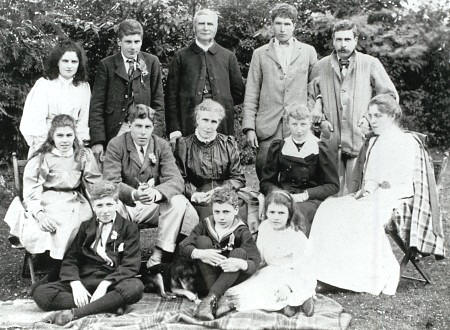
The Powys Family (late 1890s)
Marian, Albert, Charles Francis (father), John Cowper,
Theodore,
Philippa (Katie), Littleton, Mary Cowper (mother), 

Margaret, Gertrude,Llewelyn, William, Lucy.
It was not a large room into which Mr Powys took me and it was full of personal treasures. It was a room that did not appear to be used a great deal. Besides his books and some pictures there were many photographs of his family; the whole egregious Powys clan, solus and in groups. And in the middle of a wall of photographs hung the white death mask of his brother, Llewellyn.
Swiftly, vividly, with his writer's touch he sketched brief histories of each of these relatives as we stood in front of their likenesses. And his engaging chuckle kept breaking in contagiously as he recounted some Rabelasion (sic.) anecdote of the past.
Regarding the photograph of his brother, Theodore Francis, with his tight mouth and grim visage I said that I thought that I should have been rather afraid of meeting him; he looked so forbidding and unapproachable. ''O, you would'', Mr Powys said. ''you would. He frightened Thomas Hardy. Hardy quite jumped when Theo' came into the room''. And he gave a little jump and a grunt himself to show how Hardy had been affected by the sudden appearance of his brother. ''But Mrs Hardy got on with him splendidly'', Mr Powys said. ''She quite liked him''. We chose a book, or rather four books--he insisted on my having them all--although I wondered how I was going to carry them all the way back to Birmingham. We took them downstairs for Mr Powys to inscribe them.
Cowper Powys at  Corwen

And then it was time for me to go.
With difficulty we packed the books into my small case. Around my neck I now wore the eye-filling tartan tie. Mr Powys accompanied me to the door and there embraced me and repeated his kiss on my cheek exhorting me to come again whenever I felt so inclined.
At the bottom of the road I stopped to look back before turning the corner. And there standing in the doorway of his modest house, John Cowper Powys, the author of 'Jobber Skald', 'Owen Glendower' and those two masterpieces: 'Wolf Solent' and 'A Glastonbury Romance', was smiling and waving me goodbye.


Clifford Tolchard.
165 Mansel Road. Birmingham. 10 

13 November 2014

Christianity and the Library of Alexandria - Carl Sagan

from page 364 > 366 of his book ''Cosmos - The story of cosmic evolution, science and civilisation''  - Abacus, 2013

Alexandria was the greatest city the western world had ever seen. People of all nations came there to live, to trade, to learn. On any given day, his harbours were thronged with merchants, scholars and tourists. This was a city where Greeks, Egyptians, Arabs, Syrians, Hebrews, Persians, Nubians, Phoenicians, Italians, Gauls and Iberians exchanged merchandise and ideas. It is probably here that the word cosmopolitan realized its true meaning - citizen, not just of a nation, but of the Cosmos.* To be a citizen of the Cosmos...

Here clearly were the seeds of the modern world. What prevented them from taking root and flourishing? Why instead did the West slumber through a thousand years of darkness until Columbus and Copernicus and their contemporaries rediscovered the work done in Alexandria? I cannot give you a simple answer. But I do know this: there is no record, in the entire history of the Library, that any of its illustrious scientists and scholars ever seriously challenged the political, economic and religious assumptions of their society. The permanence of the stars was questioned: the justice of slavery was not. Science and learning in general were the preserve of a privileged few. The vast population of the city had not the vaguest notion of the great discoveries taking place within the Library. New findings were not explaned or popularized. The research benefited them little. Discoveries in mechanics and steam technology were applied mainly to the perfection of weapons, the encouragement of superstition, the amusement of kings. The scientists never grasped the potential of machines to free people.** The great intellectual achievements of antiquity had few immediate practical applications. Science never captured the imagination of the multitude. There was no counterbalance to stagnation, to pessimism, to the most abject surrenders to mysticism. When, at long last, the mob came to burn the Library down, there was nobody to stop them.

The last scientist who worked in the Library was a mathematician, astronomer, physicist and the head of the Neoplatonic school of philosophy - an extraordinary range of accomplishments for any individual in any age. Her name was Hypatia. She was born in Alexandria in 370. At a time when women had few options and were treated as property, Hypatia moved freely and unselfconsciously through traditional male domains. By all accounts she was a great beauty. She had many suitors but rejected all offers of marriage. The Alexandria of Hypatia's time - by then long under Roman rule - was a city under grave strain. Slavery had sapped classical civilization of its vitality. The growing Christian Church was consolidating its power and attempting to eradicate pagan influence and culture. Hypatica stood at the epicenter of these mighty social forces.
Cyril, the Archbishop of Alexandria, despised her because of her close friendship with the Roman governor, because she was a symbol of learning and science, which were largely identified by the early Church with paganism. In great personal danger, she  continued to teach and publish, until, in the year 415, on her way to work she was set upon by a fanatical mob of Cyril's parishioners. They dragged her from her chariot, tore off her clothes, and, armed with abalone shells, flayed her flesh from her bones. Her remains were burned, her works obliterated, her name forgotten. Cyril was made a saint.

*The word cosmopolitan was first invented by Diogenes, the rationonalist philosopher and critic of Plato.
** With the single exception of Archimedes, who during his stay at the Alexandrian Library invented the water screw, which is used in Egypt to this day for the irrigation of cultivated fields. But even he considered such mechanical contrivances far beneath the dignity of science.

23 October 2014

Day of the Dead

Malcolm Lowry's mysterious demise

By D.T. Max 

The New Yorker - life and letters - December 17, 2007

Malcolm Lowry died in his cottage in the village of Ripe, in Sussex, late at night on June 26, 1957, or early the next morning. He was forty-seven years old. His wife, Margerie, found his body upstairs, on the floor of their bedroom. An autopsy revealed that Lowry, an alcoholic, had been drunk, and the doctor who examined the body found that he had swallowed a large number of barbiturates and had inhaled some half-digested food from his stomach. An inquest was held, at which a police officer, the Lowrys' landlady, and Margerie testified. The coroner ruled the fatality a ''misadventure'' - that is, an accident. Lowry had choked to death on his own vomit.

Lowry is known for his 1947 novel, ''Under the Volcano'', which chronicles the final hours of Geoffrey Firmin, an alcoholic Englishman living in Mexico, in the shadow of the Ixacihuatl and Popocatepetl volcanoes. On November 1st, the Day of the Dead, Firmin, the former British consul, finds that his estranged wife, Yvonne, has come back to town, Paralyzed by his alcoholism, he drifts from cantina to cantina, considering ways to reclaim her; but he never acts. By nightfall, Firmin is dead in a ditch, shot by Mexican paramilitaries. ''Volcano'' fuses modernist and romantic sensibilities: the story is told from shifting points of view, and Firmin's daylong odyssey is borrowed from ''Ulysses''; at the same time, Lowry's prose is fervent, laid down in unstable, looping sentences. Shortly before his death, the consul sees on a house an inscription that reads “No se puede vivir sin amar”—“One cannot live without love.” Lowry, in a 1946 letter to Margerie’s family, wrote, “ ‘Volcano’ ’s theme: ‘only against death does man cry out in vain.’ ” Dawn Powell wrote soon after the book’s publication, “In ‘Under the Volcano’ you love the author for the pain of his overwhelming understanding.”

Lowry began writing “Volcano” in his late twenties. The writing took four drafts and almost a decade. In his early attempts, he was more interested in seeing how many images and symbols he could embed in the text than in creating lifelike characters. It was only in 1939, when Lowry met Margerie, who was herself an aspiring writer, that the novel began assuming a coherent shape. Margerie suggested characters and plot turns, added sentences, and cut back Lowry’s wordiness. She was a good editor, and the only person who could manage her husband’s reckless temperament.
''Volcano'' was published to broad acclaim. The critic Mark Schorer, reviewing the book in the New York Herald Tribune,wrote that few novels “convey so feelingly the agony of alienation, the infernal suffering of disintegration.” Lowry was hailed as a successor to Joyce, who had died six years earlier. “Volcano” was a popular success, too—for a time, Lowry bragged, the book outsold “Forever Amber”.
He soon fell apart. “Success”, he wrote to Margerie’s mother, “may be the worst possible thing that could happen to any serious author”. According to Lowry’s biographers—there have been six—his drinking, always prodigious, became incapacitating. He had persecution fantasies. At times, his delirium tremens was so severe that he could not hold a pencil. Lowry worked on many books in these years—he had in mind a multipart novel called “The Voyage That Never Ends”, which would parallel the Divine Comedy, with “Volcano” in the position of the Inferno—but the manuscript that he cared most about was “October Ferry to Gabriola”, a novel about the happiest phase of his marriage, in the nineteen-forties, when he and Margerie lived in a squatter’s shack on an inlet north of Vancouver. Lowry could not make the novel come together; Margerie edited and suggested, Malcolm rewrote and rewrote, and the book slid sideways. They began fighting, in part because of their failure to tell the story of their happiness. They countered their frustrations with heavy doses of alcohol, prescription sedatives, tranquillizers, and stimulants—sodium amytal, phenobarbital, Benzedrine, Allonal, Nembutal, Soneryl. (Lowry joked that he and his wife should be known as “Alcoholics Synonymous”.) But they could not inure themselves to the pain of their creative failure. Twice, during a trip to Europe, Lowry tried to strangle Margerie. Though she was a fraction of his size, she attacked him, too. Shortly before Lowry died, he told a psychiatrist whom he was seeing that either Margerie was going to kill him or he was going to kill her.